

✦ Thero-1 Pulsar
Thero-1 Pulsar is an open-weights 9B multimodal reasoning model developed by Lothera Intelligence, engineered for high-precision Turkish and English fluency, dual-mode reasoning, structured tool execution, and native visual understanding.
Built on a 3:1 hybrid linear and full attention architecture (256K context window) and shaped through Lothera's multi-stage alignment stack, Pulsar delivers substantial gains in instruction adherence, coding, hallucination resistance, and reasoning format discipline without regressing on core general-knowledge anchors.
Model Overview
| Property | Details |
|---|---|
| Model Name | Thero-1 Pulsar |
| Developer | Lothera Intelligence |
| Parameters | 9 Billion |
| Architecture | 3:1 Hybrid Linear & Full Attention (32 layers) |
| Context Window | Up to 262,144 tokens (256K) |
| Modalities | Text & Native Vision (image-text-to-text) |
| Reasoning Modes | Dual-Mode (Think / No-Think) |
| Primary Languages | Turkish and English (multilingual capable) |
| Quantized Formats | Official GGUF + Vision mmproj → Lothera/Thero-1-Pulsar-GGUF |
| License | CC BY 4.0 |
Key Capabilities
- Dual-Mode Reasoning (
Think/No-Think): Activates structured<think>...</think>reasoning chains on complex math, STEM, and software architecture problems while responding directly with low latency on everyday queries (92.82% format discipline,+37.44over reference baseline). - Native Visual Understanding: Processes documents, diagrams, UI screenshots, and visual reasoning tasks natively alongside text.
- Natural Turkish & Bilingual Fluency: Calibrated for natural, modern Istanbul Turkish (including dynamic formal/informal sen/siz register) alongside strong English technical fluency.
- Structured Tool-Calling: 100.0% schema-adherent XML
<tool_call>generation for agentic workflows, search, and external API integrations. - Hallucination Resistance & Grounding: Trained to decline cleanly or ask clarifying questions when evidence is missing rather than fabricating facts (87.5% grounding accuracy,
+25.0over baseline). - High-Efficiency Long Context: 3:1 hybrid attention reduces KV-cache footprint dramatically while maintaining 100.0% long-context coherence on hold-out checks.
Alignment Methodology
Thero-1 Pulsar is developed using the Lothera Alignment Stack, combining four research pillars rather than indiscriminate data scaling:
- Multi-Stage Representation Alignment: Curated bilingual instruction, coding, mathematics, and tool-execution trajectories structured to preserve general world knowledge.
- Self-Generated Preference Dynamics: On-policy candidate sampling paired with deterministic code, math, schema, and format verifiers to sharpen reasoning reliability and reduce verbosity.
- Verifiable Reasoning Synthesis: Targeted calibration across
<think>and direct-response regimes so reasoning tokens are spent where they improve accuracy. - Regression-Guarded Consolidation: Final identity, tone, and fluency consolidation evaluated continuously against zero-leakage regression anchors.
Evaluation (Thero-Bench · 195 Unseen Questions)
Thero-1 Pulsar was evaluated head-to-head against Qwen3.5-9B on Thero-Bench (195) — a 100% unseen, zero-leakage hold-out suite (104 Turkish + 91 English questions completely excluded from every training and alignment stage), covering both general-knowledge regression anchors and core production capabilities.
Both models were tested on identical hardware, identical system prompts, and identical per-bucket token budgets (No-Think: 512, Think-General: 1024, Think-Math/GPQA: 1600), followed by a symmetric manual audit across all 195 unseen items.
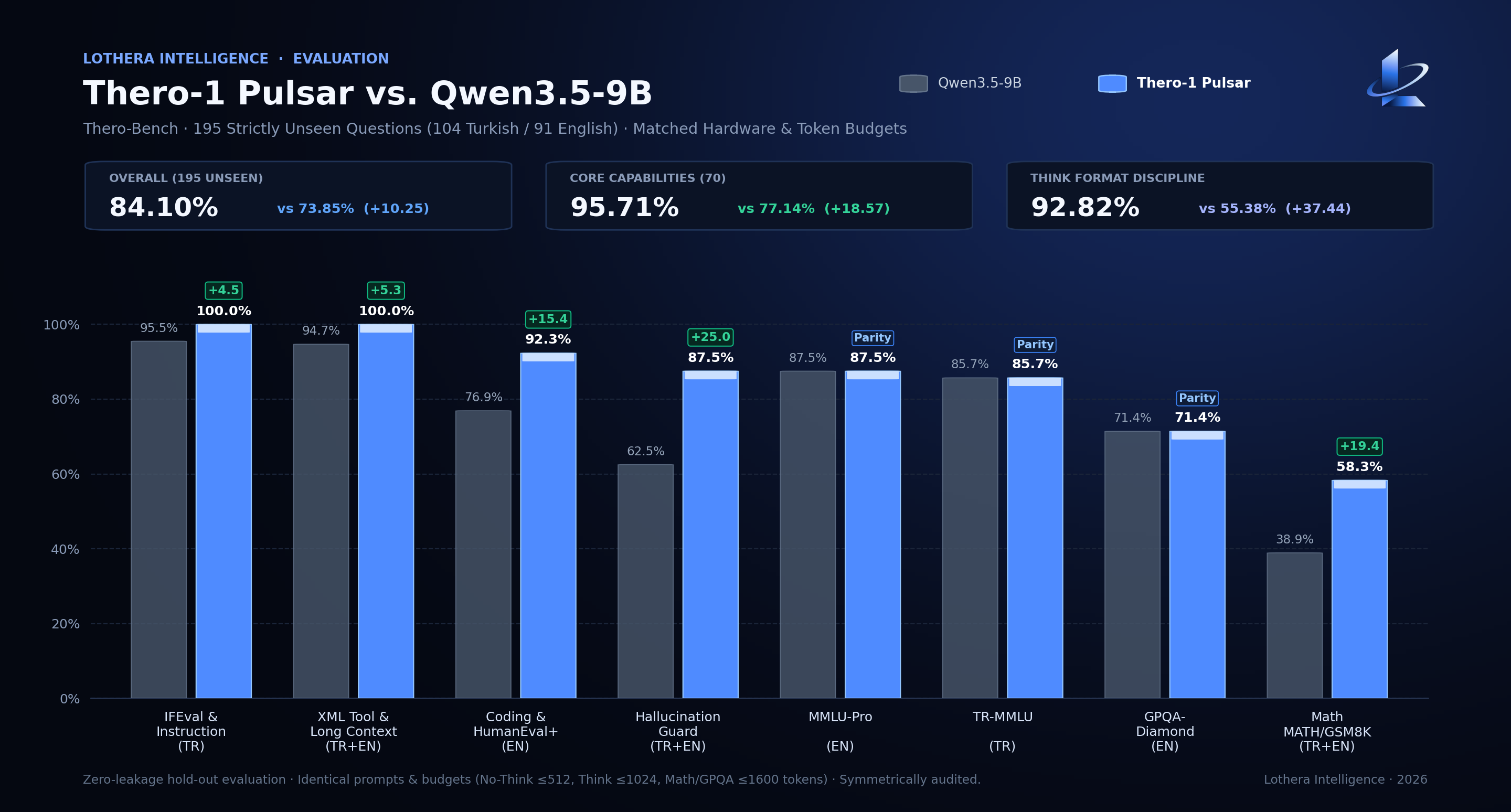
Headline Summary (195 Unseen Questions · 104 TR / 91 EN)
| Category | Unseen Items | Qwen3.5-9B | Thero-1 Pulsar | Delta |
|---|---|---|---|---|
| Overall Score | 195 | 73.85% | 84.10% | +10.25 |
| Core Capabilities | 70 | 77.14% | 95.71% | +18.57 |
| Regression Anchor | 125 | 72.00% | 77.60% | +5.60 |
| Think / No-Think Format Discipline | 195 | 55.38% | 92.82% | +37.44 |
Domain Breakdown (Unseen Hold-Out)
| Benchmark / Domain | Language | Qwen3.5-9B | Thero-1 Pulsar | Delta |
|---|---|---|---|---|
| IFEval & Instruction Adherence | TR | 95.5% | 100.0% | +4.5 |
| XML Tool-Call & Long Context | TR + EN | 94.7% | 100.0% | +5.3 |
Coding (HumanEval+ & Architecture) |
EN | 76.9% | 92.3% | +15.4 |
| Hallucination Guard (Refusal & Grounding) | TR + EN | 62.5% | 87.5% | +25.0 |
| MMLU-Pro | EN | 87.5% | 87.5% | +0.0 |
| TR-MMLU | TR | 85.7% | 85.7% | +0.0 |
| GPQA-Diamond | EN | 71.4% | 71.4% | +0.0 |
Mathematics (MATH-500 & GSM8K) |
TR + EN | 38.9% | 58.3% | +19.4 |
Note: All 195 evaluation prompts are strictly unseen hold-out items evaluated under matched inference budgets (≤1600 tokens for reasoning). Full-suite external leaderboard evaluations will be added as additional testing is completed.
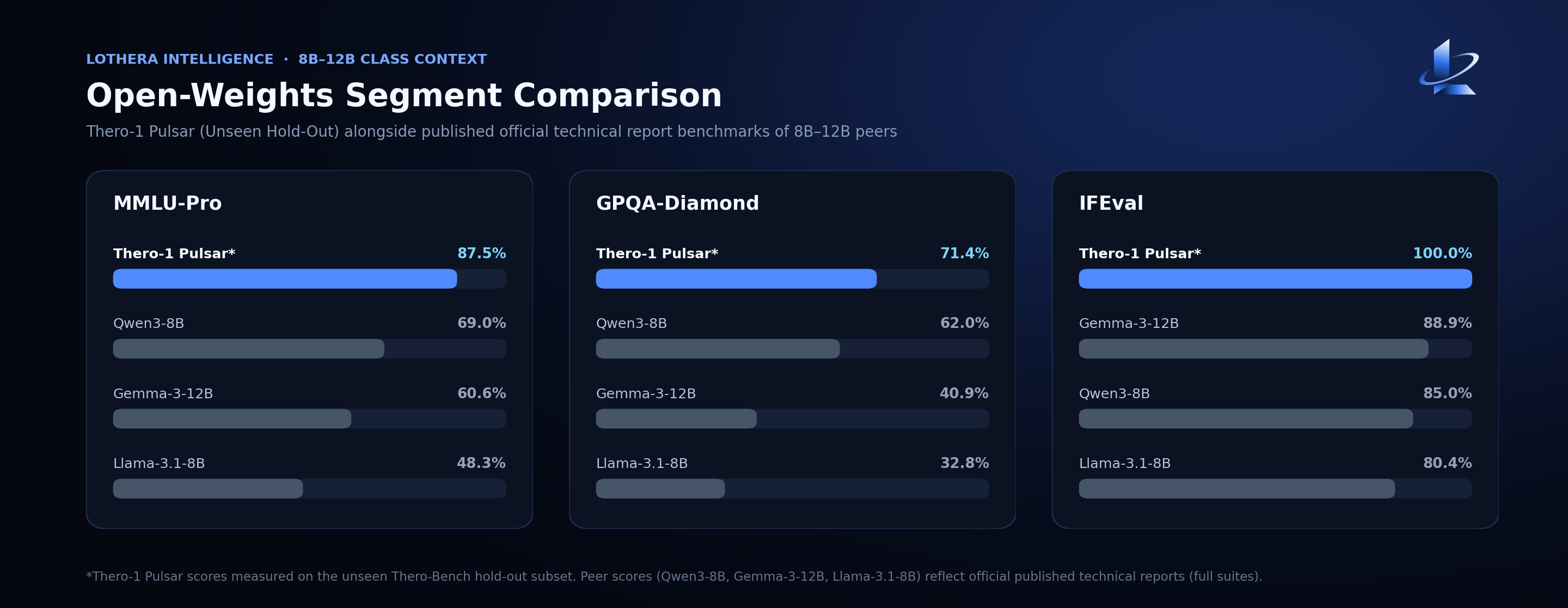
8B–12B Open-Weights Segment Context
Recommended Inference Settings
Because Thero-1 Pulsar operates over a 248K-token vocabulary, we strongly recommend top_k = 20 for optimal Turkish/English fluency and reasoning stability:
{
  "temperature": 0.55,
  "top_p": 0.80,
  "top_k": 20,
  "repetition_penalty": 1.03
}
Quickstart (transformers)
import torch
from transformers import AutoModelForImageTextToText, AutoProcessor

model_id = "Lothera/Thero-1-Pulsar"

processor = AutoProcessor.from_pretrained(model_id)
model = AutoModelForImageTextToText.from_pretrained(
    model_id,
    torch_dtype=torch.bfloat16,
    device_map="auto",
)

messages = [
    {"role": "user", "content": [{"type": "text", "text": "Merhaba! Kendini kısaca tanıtır mısın?"}]}
]

text = processor.apply_chat_template(
    messages,
    tokenize=False,
    add_generation_prompt=True,
    enable_thinking=False,  # Set True for complex math, STEM, or architecture tasks
)
inputs = processor(text=[text], return_tensors="pt").to(model.device)

with torch.inference_mode():
    output_ids = model.generate(
        **inputs,
        max_new_tokens=512,
        do_sample=True,
        temperature=0.55,
        top_p=0.80,
        top_k=20,
        repetition_penalty=1.03,
    )

print(processor.decode(output_ids[0][inputs.input_ids.shape[1]:], skip_special_tokens=True))
Local & Quantized Inference (Ollama / GGUF / LM Studio)
Run directly with a single command via Ollama:
ollama run lothera/thero-1-pulsar
For llama.cpp, LM Studio, and 6 GB – 16 GB GPUs / Apple Silicon, use our official imatrix-calibrated GGUF and Vision mmproj releases at Lothera/Thero-1-Pulsar-GGUF.
Multimodal Scope & Roadmap
- Vision (Available Now): Native visual encoding and multimodal reasoning are active in this release (
image-text-to-text). - Audio (Upcoming Roadmap): Native speech input integration is part of the next Pulsar milestone and is not included in the current checkpoint weights.
Intended Use
Thero-1 Pulsar is designed for:
- Bilingual (Turkish / English) AI assistants and SaaS copilots
- Developer tools, code generation, and technical debugging
- Structured tool-calling and agentic workflows
- Document, diagram, and image-grounded AI applications
- Open-weights research and local on-device deployment
Limitations
Like all 9B-scale language models, Thero-1 Pulsar may:
- Produce inaccurate or outdated factual claims when external retrieval is not provided.
- Make arithmetic or multi-step logical errors on competition-grade reasoning tasks, particularly under tight token budgets.
- Misinterpret low-resolution, heavily occluded, or dense visual inputs.
- Exhibit sensitivity to sampling parameters if
top_kis left unconstrained on non-English prompts.
The model should not be used as a substitute for qualified human oversight in safety-critical, medical, legal, or financial decisions.
License
Thero-1 Pulsar is released under the Creative Commons Attribution 4.0 International (CC BY 4.0) license.
Users must provide appropriate attribution to Lothera Intelligence and identify the model when redistributing or adapting it, in accordance with the license terms: https://creativecommons.org/licenses/by/4.0/
This license applies to the Lothera Intelligence release and does not supersede the licensing terms of upstream components or underlying models.
Acknowledgements
Thero-1 Pulsar builds upon the open-weights Qwen model family (Qwen/Qwen3.5-9B). We thank the open-source AI community and upstream contributors whose work makes transparent, reproducible model research possible.
Developed by Lothera Intelligence.
✦ Lothera Intelligence
Building intelligence beyond boundaries.
- Downloads last month
- 36